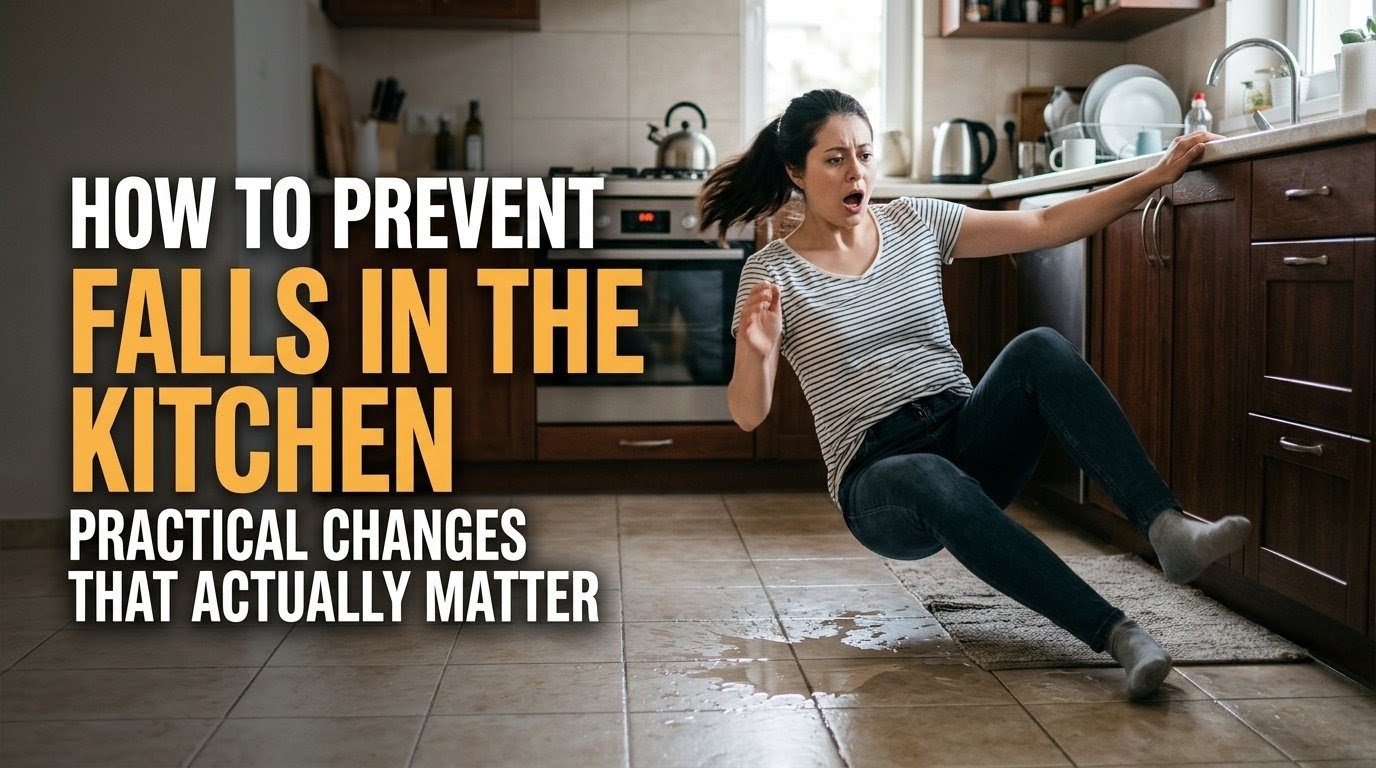
My grandmother fractured her hip in her own kitchen. She slipped on a small throw rug near the sink that had been there for years. It was the kind of hazard everyone walks past every day without registering it as dangerous – until it isn’t.
Falls in the kitchen are more common than most people think. According to the CDC, falls are the leading cause of injury for adults ages 65 and older, with over 14 million older adults – roughly one in four – reporting a fall every year. And the kitchen is one of the highest-risk rooms in the house because it combines hard floors, spills, poor lighting, and frequent distraction all in one space.
Disclosure: This post may contain affiliate links. If you buy through these links, I may earn a small commission at no extra cost to you. As an Amazon Associate, I earn from qualifying purchases.
The Most Dangerous Things in Your Kitchen Right Now
Before you can fix the problem, you need to see it clearly. Most fall hazards in a home kitchen aren’t dramatic – they’re small, familiar, and easy to overlook precisely because they’ve always been there.
Throw Rugs and Unsecured Mats
This is the single most common kitchen fall hazard, and the one people are most reluctant to address because their rugs are often decorative. Throw rugs look nice and can keep floors clean, but they are a serious tripping hazard – especially for anyone who has difficulty lifting their feet more than a few inches off the ground.
A rug without a non-slip backing slides forward when you step on it. A rug with a non-slip backing that has worn out does the exact same thing. Check any mat in your kitchen right now by pressing down on the edge and lifting – if it moves at all, it’s a hazard.
If you want to keep rugs in the kitchen, replace them with purpose-built anti-fatigue mats that have beveled rubber edges and a heavy nitrile or PVC backing that grips the floor. Beveled edges matter more than most people realize – a flat square edge is a lip that catches toes.
Spills Left on the Floor
Spills that dry and leave a sticky residue are just as dangerous as fresh wet spills. A sticky patch can catch your foot mid-step and pull you off balance just as effectively as a puddle can make you slide. Cleaning up immediately isn’t just good housekeeping – it’s the single fastest fall prevention habit you can build.
Keep a small mop or absorbent cloth within arm’s reach of your cooking area so cleaning up doesn’t require a trip across the kitchen.
Cluttered Floors and Open Cabinet Doors
A cluttered workspace increases the odds of falling. Open cupboards and drawers are among the more common floor-level hazards in home kitchens – and magnetic catches for cabinets and drawers can help keep them closed and out of the walking path.
The real problem with clutter isn’t just the items themselves – it’s that when you’re carrying something hot or heavy, your eyes are on what you’re carrying, not on what’s on the floor.
How to Fix Your Kitchen Floor for Better Fall Prevention
Your flooring situation affects fall risk more than almost anything else in the kitchen. Here’s how to address it at every level, from the surface itself to what you put on top of it.
Choose the Right Surface Treatments
Skip the floor wax entirely. Shiny kitchen floors look great in photos but are a completely different story to walk across. Whether you have tile, wood, or linoleum, waxing increases slip risk significantly. If your floors already have a wax buildup, a commercial wax stripper will remove it.
For tile floors with smooth glazed surfaces, applying a non-slip sealer designed for residential tile is an option. These products add microscopic texture to the surface without changing the look. They typically cost $30 to $60 for a standard kitchen.
Use the Right Mats in the Right Spots
The two highest-risk zones for kitchen spills are in front of the sink and in front of the stove. These are exactly where anti-fatigue mats belong. A quality mat here does double duty – it gives you cushioning during long prep sessions and provides a grip surface that your bare tile doesn’t.
Purpose-built kitchen anti-fatigue mats use closed-cell nitrile or PVC construction that resists grease and oils, features drainage holes to evacuate standing liquid, and provides anti-slip properties that reduce falls in spill-prone areas. These are a real step up from decorative fabric rugs in both safety and durability.
Look for mats that are at least 3/8 inch thick, have a textured top surface (not smooth), and a rubber bottom that grips both tile and hardwood without sliding.
Repair Damaged Flooring Immediately
Uneven surfaces, damaged flooring materials, or changes in walking surfaces cause unintentional falls. Repair or replace flooring that is damaged, or recoat it to maintain the floor’s structural integrity.
A cracked tile, a lifted vinyl edge, or a warped hardwood plank are all trip hazards. These repairs cost far less than an emergency room visit. If a tile is cracked flush with the surface it may seem harmless – but grout that’s worn below the tile edge creates a ridge your toe can catch.
Lighting: The Kitchen Fall Hazard Nobody Talks About Enough
Poor lighting is responsible for far more kitchen falls than most people attribute to it. You can’t avoid what you can’t see – and most kitchen lighting setups have blind spots that make spills, floor-level objects, and step-down transitions genuinely hard to detect.
Add Under-Cabinet Lighting
The Illuminating Engineering Society of North America recommends 500 lux for kitchen counters and critical task areas. Most standard ceiling fixtures don’t come close to that at counter level because they’re 8 to 10 feet away. Under-cabinet LED strips put light exactly where it needs to be – directly over your prep surface – and they cost $30 to $80 for a complete kit at most home improvement stores.
Expert note: According to Jonathan Scholl, owner of design and build firm Dovetail Group, “Lighting should be installed using separate circuits to highlight the overall kitchen space – the cabinetry, and specific work zones, such as the island, stove, sink, and refrigerator – with under-cabinet lighting for all countertops. Using multiple lighting circuits with dimmers on each, you can adjust the lighting for prep work and cooking.”
Add Toe-Kick Lighting for Night Navigation
One hazard almost no competitor article addresses: the late-night kitchen trip. Walking into a dark kitchen at 2 AM to get water is a high-risk situation because your eyes haven’t adjusted and your depth perception is compromised. Toe-kick lighting installed at the base of lower cabinets illuminates the floor area during evening and nighttime navigation without requiring you to turn on the full overhead lights.
These are low-voltage LED strips that install in the toe-kick recess under your base cabinets. Motion-activated versions turn on automatically when you walk into the kitchen. Installation runs about $50 to $150 for materials depending on kitchen size.
For kitchen task lighting, neutral white LEDs in the 3,500K to 4,100K range with a Color Rendering Index (CRI) of 80 or higher give the clearest color differentiation between surfaces – which matters for seeing a spill on a light-colored floor or the edge of a step-down.
If you have the kichen and dining together, learn how to pair the lights for better aesthetics.
Smart Storage That Reduces Reaching and Climbing
A significant percentage of kitchen falls happen when someone reaches overhead, climbs onto a step stool, or bends down to a low cabinet while off-balance. Reorganizing what goes where is one of the highest-impact changes you can make.
Move High-Use Items to Waist-to-Shoulder Height
Keep frequently used pots, pans, and kitchen utensils in places where they are easy to reach without bending or stretching. Place appliances, including the microwave, at waist level where possible. A microwave mounted above the range forces you to lift heavy dishes up and out at shoulder height – one of the most unstable positions for carrying weight. A countertop microwave or a lower-mounted unit is safer.
Reserve the upper cabinets for things you use once a month or less – serving platters, holiday dishes, seasonal appliances. Everything you touch every day should live between your hip and your shoulder.
Use a Proper Step Stool, Not a Chair
If you do need to reach high shelves, use a sturdy step ladder or step stool designed for the purpose. Never substitute a chair for a safe ladder. A dining chair is unstable on a kitchen floor and has no grip surface. A two-step stool with a rubberized platform and a grab handle costs $25 to $50 and eliminates most of the risk.
The real insight here is that a step stool isn’t a sign that your storage is well-organized – it’s a sign that some items need to move. If you’re on a step stool multiple times a week, that’s a reorganization problem, not a tools problem.
Footwear, Habits, and the Things You Can Change Right Now
Some fall prevention happens before you even set foot in the kitchen.
Wear Non-Slip Footwear
Socks on tile are a significant fall risk – more so than bare feet in many cases because socks provide no grip and can slide freely. Choose footwear with strong, non-slip soles for time spent in the kitchen. Slip-resistant house slippers or lightweight kitchen clogs with rubberized soles are a real upgrade over cotton socks.
Slow Down When Carrying Hot or Heavy Items
Most kitchen falls happen when someone is moving quickly while carrying something. Deliberate, careful movement – especially when carrying heavy or hot items – and holding onto sturdy countertops for support when needed significantly reduces fall risk. This sounds obvious, but the kitchen is exactly where people rush.
Before you carry a heavy pot from the stove to the sink, make sure your path is completely clear. Move any chairs, bags, or items off the floor first. Ten seconds of prep prevents a disaster.
Prepare food while seated when possible, especially during long cooking sessions, to reduce fatigue and the loss of balance that comes with it.
Fatigue is an underappreciated fall risk. Standing for 45 minutes straight while cooking a complex meal tires your legs and core, making it harder to recover from small stumbles. A tall counter stool at your prep area lets you work while seated and eliminates that fatigue entirely.
Kitchen Layout Changes Worth Making
If you’re renovating or even just reorganizing, a few layout adjustments make a permanent difference.
Maintain Clear Walkways
The minimum clearance for comfortable kitchen navigation is 42 inches between facing counters or cabinets, and 48 inches is better for households where multiple people cook simultaneously. If your kitchen has a narrower galley-style layout, be especially disciplined about keeping countertops and floors clear of anything that doesn’t belong there permanently.
Address Step-Down Transitions
Many older kitchens have a small step down at the threshold between the kitchen and an adjacent dining room or family room. These are among the most dangerous features in any kitchen because they’re often not painted a contrasting color, poorly lit, and positioned exactly where someone is carrying food. Adding a strip of contrasting non-slip tape along the step edge, and ensuring that the transition area is well-lit, costs almost nothing.