
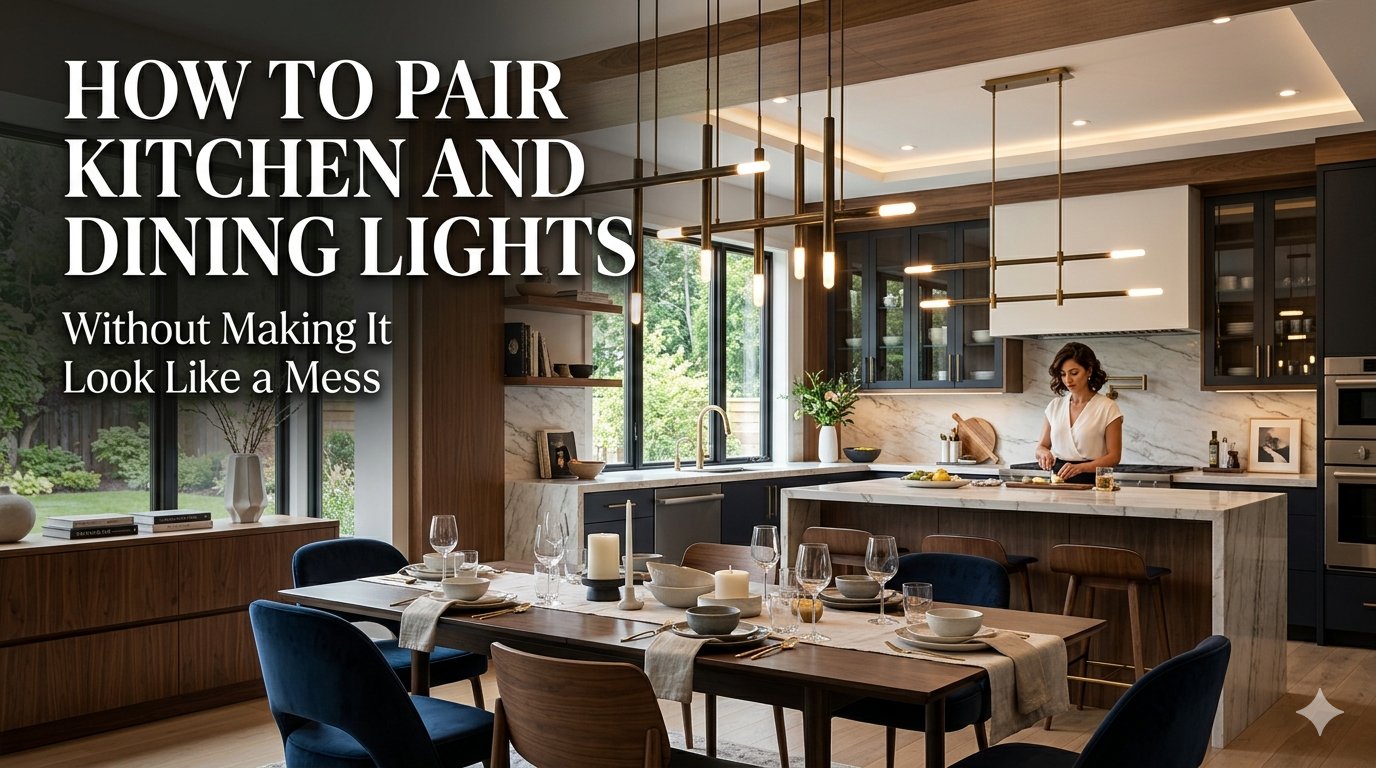
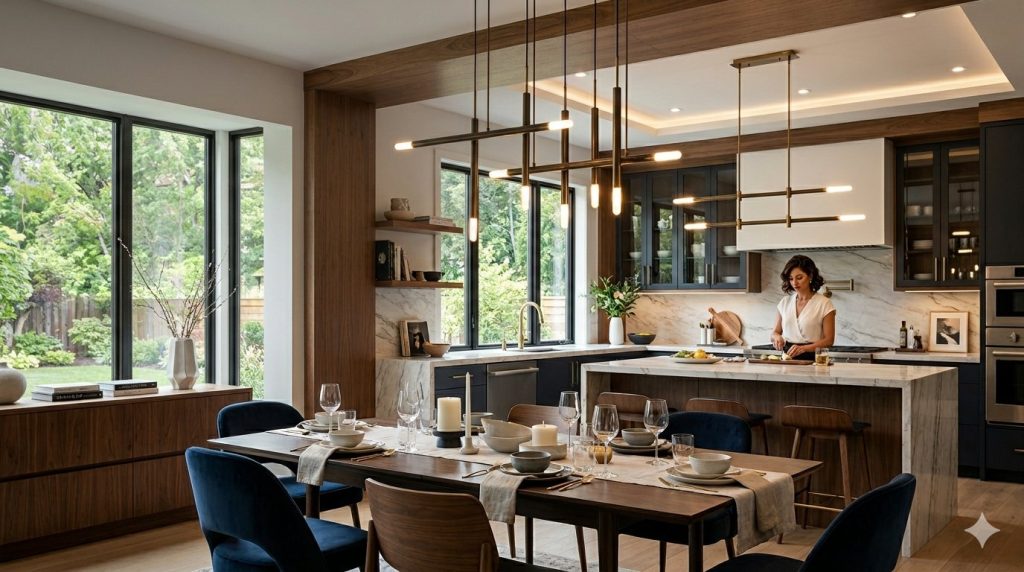
Let me be honest with you, I used to think lighting was just about screwing in a bulb and calling it a day. Then I redid my kitchen, got a gorgeous pendant light, and completely ignored the dining area next to it.
The result? Two rooms that looked like they belonged in completely different houses. Not a great look.
If you’re reading this, you probably want to avoid that mistake. Good news: you can pair kitchen and dining lights only if you know a few simple rules, and I’ll walk you through all of them right here.
Disclosure: This post may contain affiliate links. If you buy through these links, I may earn a small commission at no extra cost to you. As an Amazon Associate, I earn from qualifying purchases.
Understanding the Fundamentals of Kitchen and Dining Lighting
The Role of Lighting in Home Design
Lighting does a lot more than help you see. It sets the mood, makes your space feel bigger or cozier, and pulls your whole decor together. When your kitchen and dining lights work as a team, the two spaces feel connected and intentional.
Types of Lighting: Ambient, Task, and Accent
There are three main types of lighting you need to know:
- Ambient lighting is your main source of light — it fills the whole room. Think recessed ceiling lights or a big chandelier.
- Task lighting is focused light for specific jobs — like under-cabinet lights for chopping veggies or a pendant over your island.
- Accent lighting is decorative — spotlights on a beautiful tile backsplash or inside a glass cabinet.
A well-lit kitchen and dining area uses all three. Most people only do ambient. Don’t be most people.
Why Coordinated Lighting Matters for Kitchens and Dining Areas
If your kitchen has cool-white recessed lights and your dining area has a warm-yellow chandelier, your eye will immediately notice the disconnect, even if you can’t put your finger on why it feels wrong.
Coordinated lighting creates a visual flow that makes both spaces feel like one beautiful, intentional home.
Assessing Your Kitchen and Dining Space
Measuring Your Space and Identifying Key Zones
Before you buy a single light fixture, grab a measuring tape. Here’s what you need to know:
- Ceiling height — This affects how low you can hang pendant lights or chandeliers.
- Room dimensions — A large open kitchen needs more lights than a small galley kitchen.
- Island or table size — The size of these surfaces determines how many pendants you need and how big your chandelier should be.
A general rule: your chandelier’s diameter (in inches) should roughly equal the length plus width of your dining table (in feet). So for a 4×3 ft table, look for a chandelier around 28–30 inches wide.
Considering Natural Light and Existing Fixtures
Walk through your space at different times of day. A north-facing kitchen with little natural light needs brighter, warmer artificial light. A sun-drenched dining room may need dimmer, softer fixtures.
Also check what electrical boxes are already in place. Adding new wiring costs money and sometimes it’s smarter to work with existing fixture locations.
Defining Your Style
Are you going for modern, farmhouse, traditional, industrial, or coastal? Pick one (or a close mix of two) and stick to it across both spaces. Your lighting should match your cabinet hardware, your faucets, and your overall vibe.
Principles for Pairing Kitchen and Dining Lights
This is the heart of it. These four principles are all you really need.
Matching Finishes and Materials
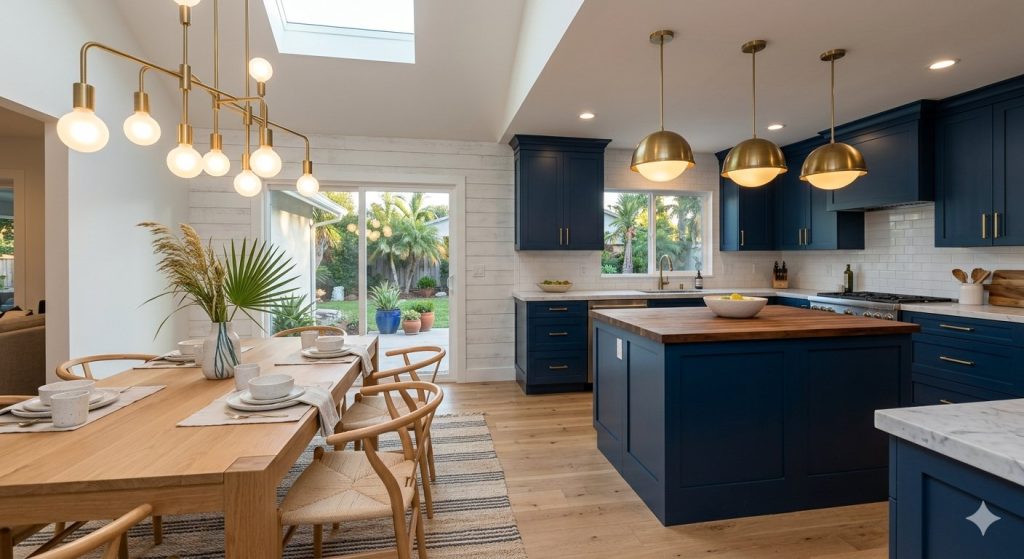
If your kitchen pendants are matte black, your dining chandelier should also be matte black; or at least a very close companion like dark bronze. Mixing brushed nickel with brass, for example, works only if you’re intentional about it (and consistent throughout the space).
Popular finish combos that work well:
- Brushed nickel + chrome (classic, clean)
- Matte black + dark bronze (bold, modern)
- Antique brass + warm gold (farmhouse, glam)
- Satin brass + natural wood accents (warm contemporary)
Harmonizing Styles and Silhouettes
Your fixtures don’t have to be identical, but they should belong to the same “family.” A sleek cylindrical pendant in the kitchen pairs well with a ring chandelier in the dining room. Both are geometric and modern.
What doesn’t work: a rustic lantern pendant with a crystal glam chandelier.
Think of it like dressing for a wedding. You don’t all wear the same outfit, but you all look like you belong together.
Considering Scale and Proportion
This is where a lot of people go wrong. A tiny pendant over a huge island looks sad. A massive chandelier in a small dining nook feels suffocating.
Quick sizing guide:
- Pendants over an island: Hang them 30–36 inches above the countertop. For a 4-foot island, two pendants work. For 6+ feet, go with three.
- Dining chandelier: Bottom of the fixture should sit 30–36 inches above the tabletop.
- Recessed lights: Space them roughly half the ceiling height apart. 8-foot ceiling = 4 feet between lights.
Using Color Temperature (Kelvin) Effectively
Color temperature is measured in Kelvin (K). This is huge and most homeowners ignore it completely.
- 2700K–3000K = Warm white (cozy, like traditional incandescent bulbs — great for dining)
- 3000K–3500K = Neutral white (clean, works in kitchens)
- 4000K+ = Cool/daylight white (very bright, better for garages or offices)
My advice: Keep your kitchen and dining area within the same Kelvin range, ideally both between 2700K and 3000K. This gives you warm, inviting light in both spaces that still lets you see what you’re cooking.
Specific Lighting Strategies for Kitchens
Overhead Ambient Lighting: Recessed Lights and Chandeliers
Recessed lights (also called can lights or downlights) are the workhorse of kitchen lighting. Space them evenly, about 4 feet apart for 8-foot ceilings. Don’t point them directly at shiny surfaces or you’ll get glare.
If your kitchen has an open layout with a central focal point (like a big island), a statement semi-flush mount or even a small chandelier can work beautifully over it.
Task Lighting: Under-Cabinet, Pendant, and Track Lights
Under-cabinet lights are a game changer. They eliminate shadows on your countertop when you’re prepping food. LED strip lights or puck lights both work well, just make sure they’re warm white to match the rest of your space.
Pendant lights over an island or peninsula are functional AND decorative. Choose pendants that are large enough to make a statement but don’t block your line of sight across the kitchen.
Track lighting is a flexible option if you need to light multiple zones, you can angle each head differently.
Accent Lighting: Spotlights for Art or Features
Do you have a beautiful tile backsplash, open shelving, or glass-front cabinets? Light them up. Small LED spotlights or in-cabinet lighting add depth and drama. This is the layer most people skip — and it’s the one that makes a kitchen look magazine-worthy.
Specific Lighting Strategies for Dining Areas
The Dining Room Chandelier: Focal Point and Function
The chandelier is the star of your dining room. It should be impressive but not overwhelming. As mentioned earlier, hang the bottom 30–36 inches above the table.
If you have very high ceilings (10 feet+), you can go a bit lower, but never so low that someone sitting down feels cramped.
For rectangular tables, a linear chandelier or two smaller pendants work better than one round fixture.
Layering with Wall Sconces and Table Lamps
Wall sconces on either side of a dining room window or buffet add warmth and dimension. They’re especially great in dining areas that double as entertaining spaces. A pair of simple metal sconces in the same finish as your chandelier ties everything together beautifully.
If you have a buffet or sideboard, a table lamp with a warm-toned shade adds another layer of cozy light. perfect for dinner parties.
Creating Ambiance with Dimmers
This is non-negotiable in my opinion. Every dining area light should be on a dimmer. Full brightness is great for homework or board games.
30% brightness is perfect for a romantic dinner. Dimmers give you total control over the mood without buying new fixtures.
Most modern LED bulbs are dimmer-compatible, just check the packaging before you buy.
DIY Installation and Coordination Tips
Tools and Safety Precautions
Before you touch any fixture, turn off the power at the circuit breaker, not just the wall switch. Use a voltage tester to confirm the power is actually off. That’s a non-negotiable step.
Basic tools you’ll need:
- Voltage tester
- Flathead and Phillips screwdrivers
- Wire stripper
- Ladder (tall enough to work comfortably, don’t stand on the top step)
- Electrical tape
Wiring Basics and Considerations
Swapping out a fixture for a new one in the same location is very doable DIY. You’re just disconnecting old wires (black to black, white to white, green/copper to ground) and connecting new ones.
But if you need to add a new electrical box, run new wiring, or install recessed lights where there aren’t any, that’s when you call an electrician. It’s not worth the risk or the potential code violations.
Using Smart Lighting and Controls for Convenience
Smart bulbs (like Philips Hue or LIFX) let you control brightness and even color temperature from your phone or with voice commands. You can set “scenes” like “dinner mode” that dims everything to 40% warm light, with a single tap.
If you don’t want to go full smart home, a simple dimmer switch is the easiest upgrade you can make. Around $15–$25 and totally DIY-friendly.
Troubleshooting Common Lighting Issues
Flickering lights: Usually a loose bulb, a bulb that’s incompatible with your dimmer, or a wiring issue. Try tightening the bulb first. If the flickering continues, replace the dimmer with a LED-compatible one.
Uneven light: Probably a spacing issue with your recessed lights, or you need to add task lighting to dark corners.
Bulb burning out too fast: You may be using the wrong wattage, or there’s a heat issue in the fixture. Switch to LED, they last years longer and run much cooler.
Inspiration and Examples: Coordinated Kitchen and Dining Lighting Styles
Here are some real-world combos that work beautifully:
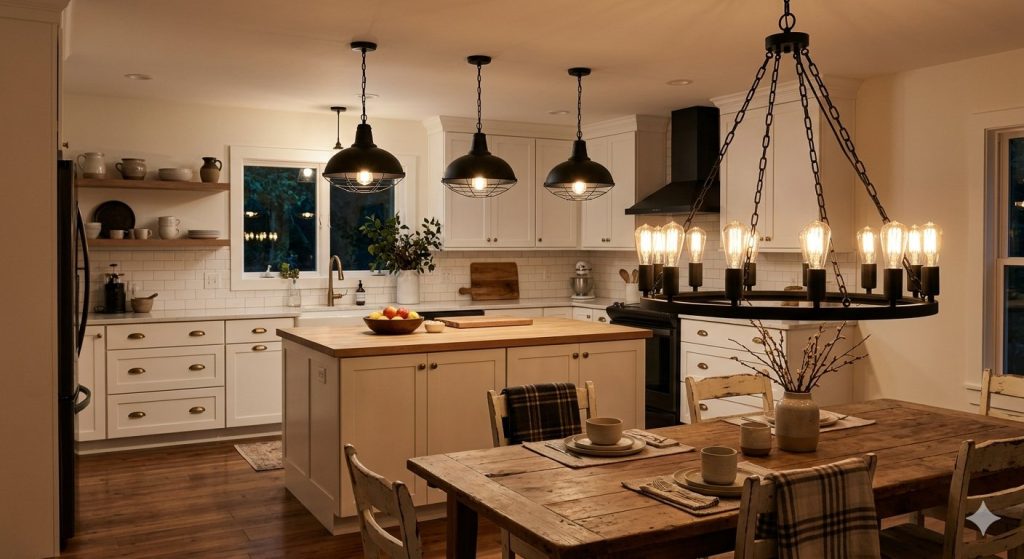
Modern Farmhouse: Matte black industrial pendants over a white shaker cabinet kitchen, paired with a black iron wagon-wheel chandelier over a farmhouse dining table. Add warm 2700K bulbs throughout.
Transitional/Classic: Brushed nickel recessed lights and a drum pendant over the island, paired with a brushed nickel crystal chandelier in the dining room. Feels timeless and elegant.
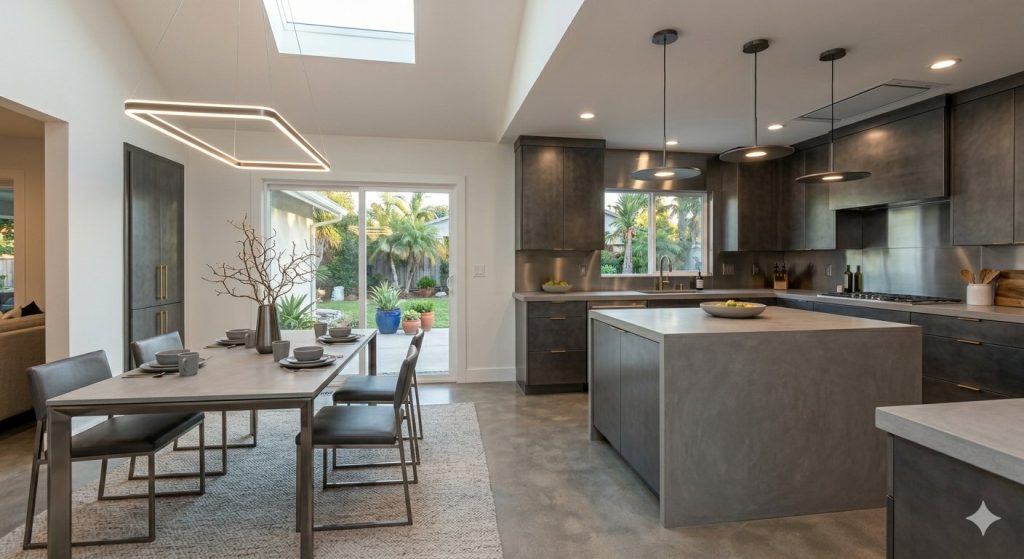
Contemporary Minimalist: Sleek, low-profile disc pendants in gunmetal over a waterfall-edge island, with a simple linear LED chandelier in the dining room. Clean, modern, sophisticated.
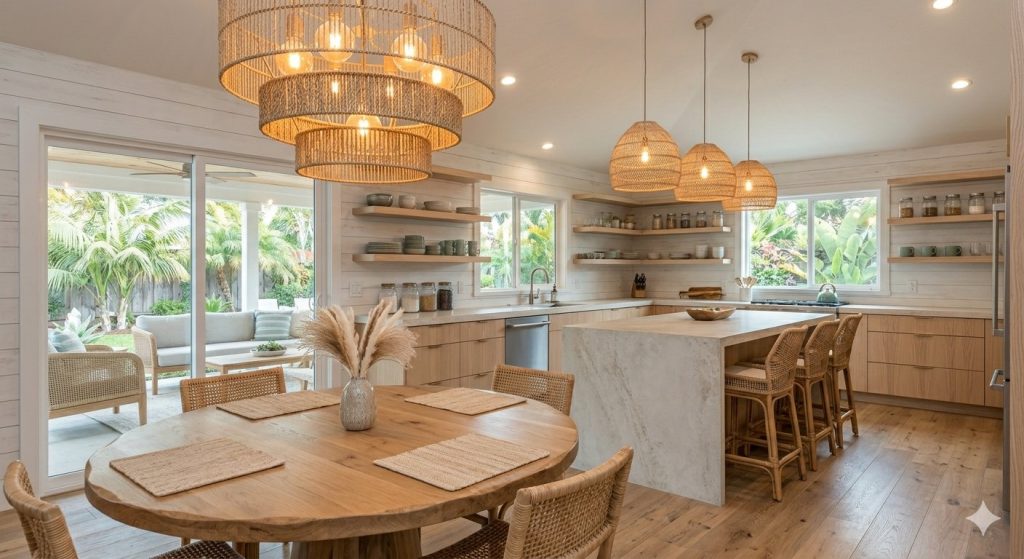
Coastal/Boho: Rattan or woven pendant lights over the kitchen island, with a large rattan chandelier in the dining room. Natural materials, warm bulbs, total relaxed-beach vibes.
The secret in every example? Same finish. Same Kelvin. Same style family. That’s all it takes.
Light Up Your Home the Right Way
Pairing kitchen and dining lights doesn’t have to be stressful. Pick your finish, nail the Kelvin temperature, match your style family, and get your sizes right. Do those four things and your space will look like it was designed by a professional, even if you did it all yourself on a Sunday afternoon.
Start with the biggest fixture first (usually the dining chandelier), then build everything else around it. And if you’re ever unsure, matte black and warm white bulbs are almost always a safe bet that looks amazing in almost any home.
You’ve got this.