
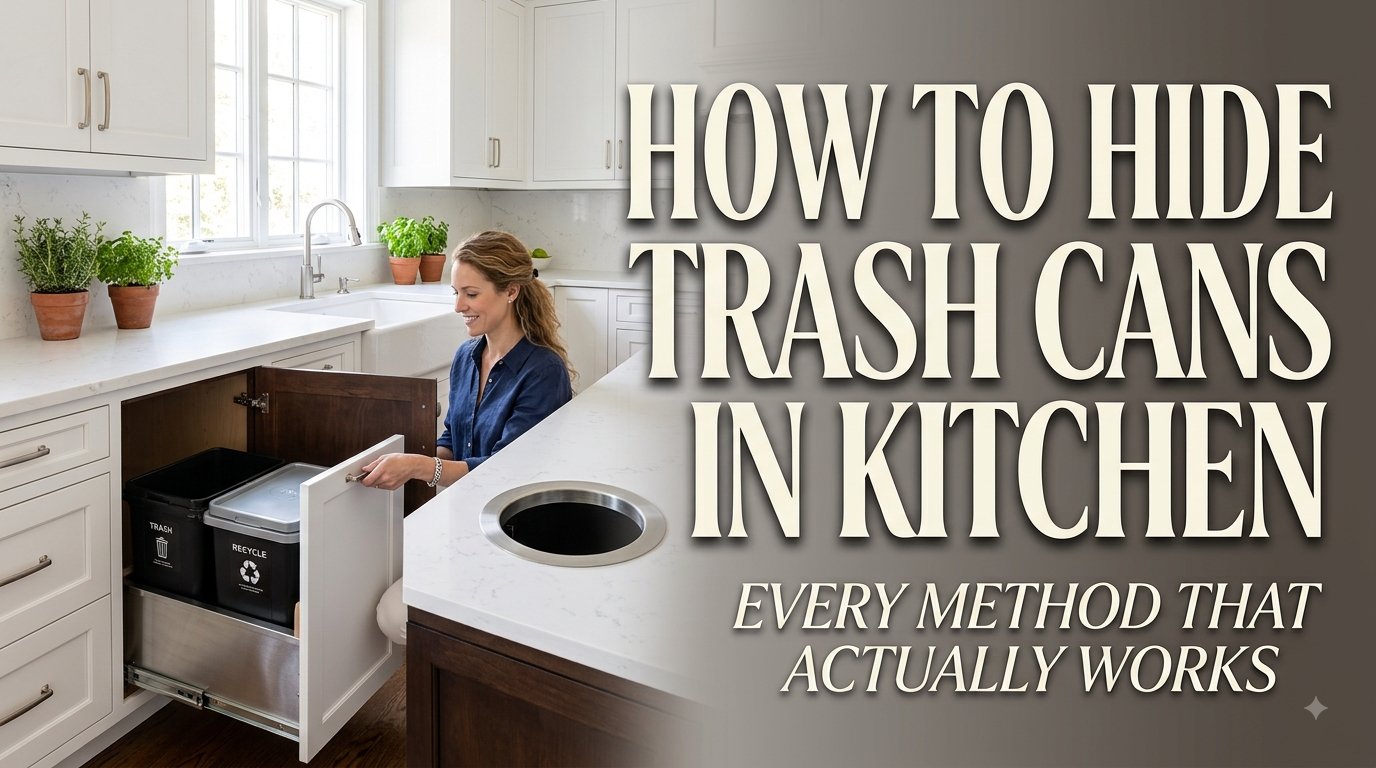
Every kitchen has a trash can problem. It sits in the middle of everything, it smells, and it refuses to blend in no matter what color you paint the walls around it. Figuring out how to hide trash cans in the kitchen sounds simple until you actually try to do it without giving up cabinet space you need for something else.
The right solution depends on how much cabinet space you have, whether you rent or own, and whether recycling needs a home too. This covers every method that actually works in a real kitchen, with real measurements and honest tradeoffs.
Disclosure: This post may contain affiliate links. If you buy through these links, I may earn a small commission at no extra cost to you. As an Amazon Associate, I earn from qualifying purchases.
The Best Built-In Ways to Hide Trash Cans in Kitchen Cabinets
Built-in solutions look the cleanest and stay the most convenient. If you have any base cabinet space to work with, start here.
Pull-Out Trash Can Inside a Base Cabinet
This is the most popular built-in method, and it earns that reputation. Pull-out trash bins are a discreet storage method; the bins stay hidden behind the cabinet door, everything looks the same, and the system just slides out when you need it.
The key number is cabinet width. A 15-inch base cabinet fits a single 35-quart pull-out bin. An 18-inch cabinet handles either a double 27-quart system or a single 50-quart bin. Measure your cabinet’s interior opening, not the exterior, before ordering any kit.
Two brands dominate this category: Rev-A-Shelf and Häfele. Both offer full-extension ball-bearing slides rated at 100 to 150 lbs, soft-close undermount mechanisms, and door-mount brackets that attach the bin to the existing cabinet door. You don’t need to replace the door as the existing door becomes the pull-out face.
One thing almost every guide skips: if double-bin lids are in the plan, measure the lid diameter against the center divider width before buying. Lids that collide when both are open are the most common post-installation complaint on double-bin systems.
Pro tip from Judi Cooper, principal interior designer at Kitchens Inside Out: “Make sure to add a stainless-steel or brass drip guard on the top of the cabinet rim. This helps avoid the gumminess that comes from trash juice dripping over time.” A $15 to $20 liner tray prevents a cabinet floor replacement later.
Tilt-Out Trash Drawer
A tilt-out cabinet uses a hinged panel instead of a sliding drawer. The cabinet face swings outward on piano hinges, revealing a small bin mounted inside. These work great as standalone cabinets or as part of a kitchen island. If you go the tilt-out route, invest in a strong hinge system so heavier loads don’t wear out the rotating mechanism over time.
Tilt-out units work best in narrow spaces; a 9 to 12-inch wide cabinet that can’t fit a pull-out slide. The tradeoff is capacity. Tilt-out bins typically hold 10 to 13 gallons versus the 35-quart (roughly 9 gallons) to 50-quart (roughly 13 gallons) range of pull-out kits. For a secondary bin near the prep area, a tilt-out is excellent. For a household’s main trash, it fills fast.
Under-Sink Cabinet
The cabinet beneath the kitchen sink is one of the most common places to hide a trash can. The sink is the center of food prep and cleanup, making the location ideal for access.
The limitation nobody mentions: under-sink cabinets are usually 24 inches deep but often have plumbing blocking a significant portion of the usable floor space. A standard 13-gallon can may fit, or it may not — check the path the drain and supply lines take before assuming it will. A smaller 8-gallon can almost always fits in whatever space remains. Rev-A-Shelf makes a pull-out system specifically designed for under-sink depth that accommodates plumbing by mounting the bin to the side wall rather than the floor.
Freestanding and Furniture-Style Solutions for Any Kitchen
Not every kitchen has a spare base cabinet. These options work in rentals, small kitchens, and anywhere cabinet surgery isn’t on the table.
Kitchen Island with Built-In Trash Compartment
A kitchen island is one of the best places to hide a trash can, it typically comes up to waist height, there is a lot of usable space, and it’s prime territory for cabinet integration.
If you’re buying a new island, many freestanding models include a dedicated trash pull-out or a large enclosed cabinet on one end. For an existing island without one, a retrofit pull-out kit mounted inside an existing door opening works the same way it does in a perimeter cabinet.
The placement advantage is real. An island trash compartment sits in the center of prep activity, which means scraps travel 12 inches instead of walking across the kitchen. Countertop cleanliness improves noticeably.
Rolling Kitchen Cart with Enclosed Storage
A rolling island or kitchen cart with enclosed storage can tuck your trash can inside and still move around the kitchen as needed. This is the best option for renters who can’t modify cabinets. A cart with a solid-door lower compartment hides a standard 13-gallon can completely. Roll it next to the prep area when cooking, roll it back against the wall when done.
The realistic limitation: most kitchen carts with enclosed storage are 24 to 30 inches wide. In a small kitchen, that’s a meaningful footprint. A cart that fits the space but crowds the walkway creates more problems than it solves.
Pantry or Closet
A pantry or supply closet can be a convenient place to hide trash cans. Many pantries are spacious enough to hold at least one standard 13-gallon trash can, and some hold two or more.
This option works well for recycling bins specifically. Recycling gets emptied less frequently than daily trash, so a slightly less convenient location is fine. Dedicating a pantry corner to a row of 13-gallon bins for glass, plastic, and paper is neater than most alternatives.
The honest tradeoff: out of sight, out of mind. Bins in a pantry tend to overflow before anyone notices. If you go this route, set a reminder to check them every 3 days rather than waiting to smell the problem.
No-Cabinet Solutions When Space Is Tight
Some kitchens have no cabinet to spare and no floor space for a cart. These alternatives work without either.
Decorative Wicker or Seagrass Basket
In small kitchens, there may not be a good spot to hide a trash can. In that case, make the most of the situation and hide it in plain sight with an attractive basket. A tight-weave wicker or seagrass basket with a handle holds a standard liner and reads as a storage item rather than a trash can from across the kitchen.
The realistic version of this: it works better for dry trash than food scraps. If your trash is mostly paper, plastic wrap, and packaging, a decorative basket is genuinely practical. If you cook heavily and have a lot of wet organic waste, the basket traps odors inside the weave over time. Use a liner with a drawstring top and empty it daily.
Tension Rod Under a Sink Curtain
Kitchen sink curtains are the retro cottage-core trend making a comeback and are ideal for hiding trash cans. A tension rod mounted inside the sink cabinet opening, fitted with a cotton or linen curtain that drops to the floor, conceals whatever is underneath — including a trash can, cleaning supplies, and a recycling bag.
Cost is almost nothing: a tension rod runs $8 to $15, and cafe curtains or fabric panels cost $10 to $30. It’s a weekend project that takes 20 minutes. The tradeoff is that curtains require pushing aside to access the bin, and fabric near a kitchen sink gets splashed and grimy over time. Wash the curtain every two weeks.
The Measurement Reality Nobody Explains Upfront
Most people research a pull-out trash system, order one that looks like the right size, and then discover it doesn’t fit the way they expected. Here’s what to measure before buying anything:
- Interior cabinet opening width — not the exterior dimension. Cabinet walls eat 0.75 to 1 inch per side, so an 18-inch exterior cabinet has roughly 16.5 to 16.75 inches of interior width.
- Interior depth — standard base cabinets are 23.5 to 24 inches deep inside. Most pull-out kits are 21 to 22 inches deep, which works. But under-sink cabinets often run shallower due to plumbing.
- Height of the cabinet opening — if there’s a drawer above the door, the opening height drops to 18 to 20 inches. Larger 50-quart bins need a full-height cabinet opening; they can hit the drawer face of a door-and-drawer style cabinet if that height isn’t available.
- Slide type — door-mount brackets attach the existing cabinet door to the pull-out frame. Check that the door is solid enough to carry the added weight of the full bin without flexing or pulling the hinges.