
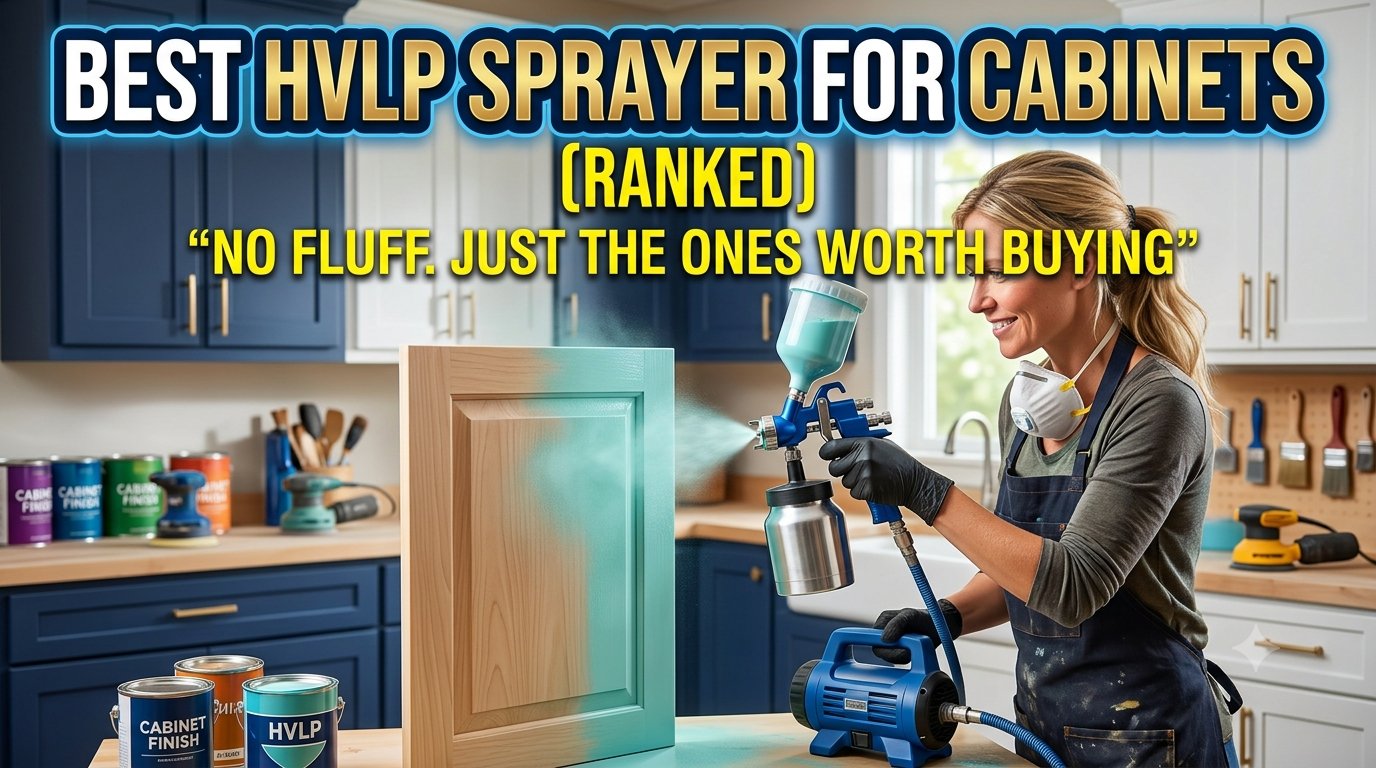
The biggest mistake buyers make is shopping by wattage. Wattage tells you how much electricity the motor draws. It says nothing about what actually matters: the PSI at the gun tip and how many turbine stages generate that pressure. Those two numbers decide whether your cabinet doors come out glass-smooth or covered in orange-peel texture you’ll be sanding off next weekend.
For cabinet-grade paints like Benjamin Moore Advance or Sherwin-Williams Emerald Urethane Trim Enamel, you need real atomization pressure. A two-stage turbine produces roughly 2.7 to 5 PSI — manageable with some thinning. A four-stage unit hits 9 PSI and sprays heavy enamel with minimal thinning. That gap in performance explains why some homeowners get a factory-smooth finish and others redo the job.
The five best HVLP sprayers for cabinets are ranked below by weighted score, not Amazon popularity, not price.
Disclosure: This post may contain affiliate links. If you buy through these links, I may earn a small commission at no extra cost to you. As an Amazon Associate, I earn from qualifying purchases.
The Best HVLP Sprayers for Cabinets, Ranked
Each product was scored across five factors: Finish Quality (35%), Viscosity Handling (20%), Ease of Use (15%), Overspray Control (15%), and Value (15%). These weights reflect what actually matters on a kitchen cabinet project.
| Product | Score | Best For |
| Fuji Mini-Mite 4 Platinum | 9.2 | Best overall — unthinned cabinet enamel, serious DIY |
| Fuji Semi-Pro 2 HVLP System | 8.6 | Best step-down — semi-pro results, lower price |
| Wagner FLEXiO 5000 | 8.0 | Best homeowner dual-use pick |
| Wagner Control Spray Max | 7.3 | Best budget stationary unit |
| HomeRight Finish Max C800766 | 6.1 | Best entry-level for chalk paint only |
1. Fuji Mini-Mite 4 Platinum | Best Overall HVLP Sprayer for Cabinets
The Mini-Mite 4 Platinum is what professional cabinet painters and serious DIYers reach for when the finish has to be right the first time. Its four-stage turbine delivers 9.0 PSI at the gun — enough to properly atomize thick waterborne cabinet enamels at 5 to 10% thinning or less.
The non-bleeder T75G gun with stainless steel fluid passages means no continuous airflow drying paint at the tip between passes, and the patented Side-Mounted Fan Pattern Control lets you adjust the fan width without changing the air cap.
Key Features:
- Patented Side-Mounted Fan Pattern Control: horizontal, vertical, and round, adjustable without tools
- Heat Dissipation Chamber routes turbine heat away from the work area
- Noise Reduction Covers on the turbine housing (quieter than standard Mini-Mite units)
- 25-foot Hi-Flex hose with quick-connect coupling and air control valve at the gun end
- #4 Ford Viscosity Cup, wrench, and cleaning brush included
- 2-year warranty on parts and labor
Pros:
- 9.0 PSI handles Benjamin Moore Advance and SW Emerald Urethane with minimal thinning. On a full set of cabinet doors, that means the paint’s self-leveling chemistry stays intact. You get the smooth, factory-like result those products are designed to produce.
- The air control valve at the gun end is a real convenience. You can cut the airflow without walking back to the turbine. On a long cabinet project, you stop and restart dozens of times. This feature alone saves 10 to 15 minutes per session.
- Stainless steel fluid passages and a non-bleeder gun produce cleaner, more consistent fans. Plastic passage guns develop micro-scratches over time that disrupt flow patterns. The stainless internals stay consistent across years of use.
Cons:
- Price is the highest on this list at around $500 or more with the T75G gun.
- The turbine and case together are heavy and bench-footprint-sized. Not a unit you carry between rooms easily.
- The gravity cup orientation requires more careful pouring and monitoring than bottom-feed designs.
Score context: Finish quality and viscosity handling both scored 10 out of 10. This is the only unit on the list that genuinely handles thick cabinet enamel at near-full viscosity with a flat, orange-peel-free result. The high price and bulk held back the value and ease-of-use scores.
Best for: The homeowner doing a full kitchen repaint who wants results that look professionally sprayed, and who is willing to invest in a tool they’ll use again on furniture, trim, and future projects.
Pro tip: Order the 1.5mm air cap set alongside the Mini-Mite 4 if you’re spraying BM Advance or a similar heavy enamel. The 1.5mm gives slightly more fluid flow than the standard 1.3mm cap, reducing the thinning needed and maintaining the paint’s self-leveling properties.
2. Fuji Semi-Pro 2 HVLP Spray System | Best Step-Down for Serious Cabinet Work
The Semi-Pro 2 runs on a 1,400-watt two-stage turbine that delivers 5.0 PSI at the gun, noticeably stronger than most consumer two-stage units, which typically top out at 2.7 to 3 PSI.
The non-bleeder spray gun design is the same philosophy as the Mini-Mite line. Combined, these two features push finish quality above what the stage count alone suggests.
Key Features:
- Non-bleeder spray gun with standard air cap set
- 25-foot flexible hose with heat-dissipating design
- 1.3mm needle included; additional air cap sizes available separately
- 1-quart gravity-feed cup
- Metal turbine carry case with gun holder
- Made in Canada; replacement air caps and needles widely stocked
Pros:
- The non-bleeder gun design closes most of the finish quality gap between this and a four-stage unit on moderately thinned cabinet paints. It doesn’t blow air between trigger pulls, so the tip stays wet and the fan stays consistent across each pass.
- At 5.0 PSI, the Semi-Pro 2 is roughly 85% more pressure than Wagner’s two-stage units at 2.7 PSI. That extra pressure is real atomization improvement on thick waterborne enamels, not a minor spec difference.
- The 25-foot hose with heat management keeps turbine exhaust heat from warming the paint in the cup during long sessions. Heat-thinned paint changes viscosity mid-project and creates inconsistent fan quality.
Cons:
- Heavy cabinet enamels at full viscosity still require 10 to 15% thinning. The four-stage Mini-Mite 4 handles these paints with 5% or less.
- The 1-quart cup feels small during a full kitchen repaint. Plan for 10 or more refills per coat on larger jobs.
- Pricing around $300 to $350 is a real commitment. The finish quality is there, but the viscosity limitation is honest.
Score context: The non-bleeder gun and above-average PSI for a two-stage unit pushed finish quality high. Viscosity handling scored lower than the Mini-Mite 4 because thick cabinet enamel still needs meaningful thinning, which compromises self-leveling behavior.
Best for: The homeowner painting a full set of kitchen cabinets who wants semi-professional finish quality and is comfortable with modest thinning, without spending $500-plus on the Mini-Mite 4.
Honest warning: The Fuji Semi-Pro 2 does not include noise reduction covers. It runs at standard HVLP turbine noise levels; expect roughly 75 to 78 dB in operation. Fine in a garage, noticeable in an occupied kitchen. Use a fan to ventilate and consider ear protection during long sessions.
3. Wagner FLEXiO 5000 | Best Dual-Use HVLP Sprayer for Homeowners
The FLEXiO 5000 is Wagner’s flagship prosumer stationary unit. It separates the turbine from the gun, keeps the spray gun lightweight, and ships with two nozzles: the iSpray for large flat surfaces and the Detail Finish nozzle for cabinets and trim.
Variable turbine speed lets you dial down pressure for thin coatings and up for thicker materials. Real users report good results on cabinet doors with BM Advance thinned about 5 to 10%.
Key Features:
- X-Boost turbine with variable speed control; 3 PSI output
- Floor-standing turbine connected by 11.2-foot hose
- Two nozzles: iSpray (broad surfaces) and Detail Finish (cabinets and trim)
- 1.5-quart cup on iSpray nozzle; smaller cup on Detail Finish nozzle
- Adjustable material flow, spray pattern direction and width, and air power output
- Lock N Go quick-disassembly system
- Five bonus cup liners included
Pros:
- The Detail Finish nozzle produces a 3-inch fan specifically sized for cabinet door panels. That narrow fan gives precise control on raised panel details without flooding the surface. Users spraying BM Advance at 5 to 10% thinning report smooth, brush-mark-free results.
- Variable turbine speed means you can match the machine to the material instead of always thinning the material to match the machine. Dial down for stains and lacquers; dial up for heavier latex.
- The dual-nozzle kit adds real project versatility. After cabinets are done, the iSpray nozzle handles exterior trim, fences, and walls without additional purchases.
Cons:
- At 3 PSI, heavy cabinet enamels at full viscosity require 10 to 15% thinning. Self-leveling properties are partially compromised at that dilution level.
- The 11.2-foot hose is significantly shorter than the 25-foot hoses on both Fuji units. The turbine base needs to sit within about 8 feet of your work surface after accounting for slack.
- At high turbine speeds, this unit runs loud. Manageable in a garage; noticeable in a kitchen.
Score context: Versatility and the dual-nozzle kit gave this unit the best value score among mid-range picks. Viscosity handling and hose length held back the finish quality and ease-of-use scores compared to the Fuji units.
Best for: The homeowner with a cabinet project now and additional outdoor or interior painting planned soon, who wants one tool for both rather than two specialized purchases.
Honest warning: The 11.2-foot hose puts the turbine base within overspray range of your work surface at typical cabinet door distances. Cover the turbine housing with a drop cloth or move it off to the side between passes to keep paint mist off the motor intake.
4. Wagner Control Spray Max | Best Budget Stationary HVLP for Cabinets
The Control Spray Max sits in a useful middle ground. It’s a stationary turbine unit, not a handheld, which means the motor weight stays on the floor, reducing arm fatigue during a long cabinet project. At 2.7 PSI and 510 watts, it’s weaker than the Fuji Semi-Pro 2, but the 20-foot hose and two included cups (1-quart metal and 1.5-quart plastic) make it a more practical setup than most budget handheld units.
Key Features:
- 20-foot flex hose connecting stationary base to spray gun
- Three spray patterns: horizontal, vertical, round
- Variable air pressure control dial and material flow adjuster
- Includes 1-quart metal cup and 1.5-quart plastic cup
- Viscosity cup included
Pros:
- Stationary base keeps the motor off your hand during long spraying sessions. Handheld units at this price point put the motor weight in your grip. After 30 minutes spraying cabinet doors at shoulder height, that weight is a real issue.
- The variable pressure dial lets you reduce PSI for thin coatings like stain or poly, minimizing overspray when switching from cabinet enamel to a lighter material on the same project.
- Two cups at different sizes is a genuine practical advantage. Use the 1-quart metal cup for solvent-based coatings and the 1.5-quart plastic for waterborne, the larger cup means fewer refills on broad door faces.
Cons:
- At 2.7 PSI, thick cabinet enamels like Emerald Urethane and BM Advance require 15 to 20% thinning. At that dilution level, the self-leveling chemistry is significantly reduced.
- The bleeder-style gun design flows air continuously, which can partially dry paint at the tip during slow passes. This shows up as slight texture on flat door panels under raking light.
- Long-term durability reports flag the plastic gun body and internal passages as the first failure points, particularly with latex paints that aren’t flushed out thoroughly after each session.
Score context: Ease of use scored well for the stationary design and included accessories. Viscosity handling and finish quality scored the lowest of the stationary units due to the 2.7 PSI limitation and bleeder gun design.
Best for: A homeowner repainting 6 to 10 cabinet doors with a thinned chalk paint or thinned cabinet enamel who needs a step up from handheld units without a $300-plus budget.
5. HomeRight Finish Max C800766 | Best Entry-Level Pick for Chalk Paint Only
The HomeRight Finish Max is the most widely sold entry-level HVLP in the US. At $50 to $65, it’s the lowest cost of entry in this category. Its single-stage 400-watt turbine handles chalk paint, milk paint, and thin stains well. For thick cabinet enamels at anything near full viscosity, it clogs, spatters, and produces uneven atomization. That’s not a knock — it’s what single-stage entry-level tools are.
Key Features:
- 400-watt single-stage turbine
- Brass spray needle and housing
- 27-ounce (0.84-quart) cup capacity; covers approximately 70 square feet per fill
- Three adjustable spray patterns: horizontal, vertical, round
- Adjustable flow control knob
- Includes viscosity cup, air nozzle, and cleaning brush
- 2-year warranty
Pros:
- The included viscosity cup removes the guesswork from thinning for new users. Most spray failures come from incorrect viscosity. Having a concrete tool to measure and target takes a variable out of the equation.
- At under 3 pounds, this is the lightest unit on the list. For a small 4 to 6-door project with chalk paint, the weight is a genuine comfort advantage over a heavier stationary setup.
- Real user reports on cabinet boxes with chalk-type paint are positive at this price point. It produces a smooth, brush-mark-free surface when the material viscosity is right.
Cons:
- Large-volume reviews flag clogging and early motor failure as recurring issues. A meaningful percentage of buyers report unit failure within 6 to 12 months of regular use. Plan on replacing it, not maintaining it.
- Heavy cabinet enamels — BM Advance, SW Emerald Urethane — are beyond this unit regardless of thinning. The pressure simply isn’t there for proper atomization of those materials.
- The 27-ounce cup means 10 to 12 refills per coat on a full kitchen cabinet repaint. Factor that time into your project estimate.
Score context: Value scored the highest of any product on the list for chalk paint use cases specifically. Finish quality, viscosity handling, and durability all scored the lowest. This tool earns its place only for the right material and the right project scale.
Best for: A homeowner painting 4 to 6 cabinet doors with chalk paint or thin milk paint enamel who wants to test HVLP spraying before committing to a higher-end turbine system.
Honest warning: Clean this unit after every use, even mid-project. The internal passages are narrow and clog fast when any latex-based paint dries inside them. A clogged unit at the start of coat two is the most-cited complaint across thousands of large-retailer reviews.
Once you’re done with the paint, you may want to find the best sealer for the painted cabinets.
What to Know Before Buying an HVLP Sprayer for Cabinets
Cabinet painting punishes underpowered spray equipment. A few things to understand before any product comparisons.
Turbine Stages Are the Only Number That Matters
A turbine HVLP is built around stacked fan motors. Each “stage” adds pressure and airflow. Two stages produce roughly 2.7 to 4 PSI at the gun. Three stages reach about 6.5 PSI. Four stages push 9 PSI. Five stages reach 9.5 PSI.
For thinned lacquers, shellac, and waterborne stains, two stages work fine. For thick self-leveling cabinet enamels at or near full viscosity, you need three stages at minimum and four for the best results. Most budget sprayers sold at home improvement stores are two-stage units even when they don’t say so. If the spec sheet doesn’t list a stage count or PSI at the gun, that’s your signal.
Why Cabinet Paint Specifically Requires More Pressure
Self-leveling cabinet enamels are thick by design. They’re built to level themselves out on vertical surfaces, which requires a specific viscosity range. Heavy thinning, beyond 10 to 15%, strips that self-leveling behavior. The paint becomes runny, sags on door faces, and needs more coats to build film thickness.
A four-stage turbine at 9 PSI sprays these products with 5 to 10% thinning or less. A two-stage unit at 2.7 PSI requires 15 to 20% thinning, which means you’re fundamentally changing the paint to match the machine. Spending more on the right sprayer costs less than ruined paint and wasted time.
Non-Bleeder vs. Bleeder Gun Design
A non-bleeder spray gun only flows air when you pull the trigger. A bleeder gun runs air continuously. For cabinet finish work, non-bleeder guns are better. Continuous airflow partially dries paint at the nozzle tip between passes. That dried material creates texture and specks in the wet finish on flat door panels. Every Fuji system uses non-bleeder guns by design. Wagner and HomeRight entry-level units typically use bleeder-style designs.
What to Measure Before You Buy
- Hose length. Stationary turbine units separate the motor from the gun. A 20 to 25-foot hose lets you spray a full set of doors without moving the turbine base. A unit with an 11-foot hose requires constant repositioning.
- Cup capacity. A 1-quart cup covers roughly 30 to 40 square feet per fill. A 20-door kitchen repaint means 8 to 12 refills per coat with a 1-quart cup. Plan accordingly.
- Needle size. A 1.3mm needle atomizes fine finishes on detailed cabinet profiles. A 1.8mm or 2.0mm tip applies paint faster but can flood smaller panel details. Confirm the included needle and whether replacement sizes are available.
- Cleanup design. Some guns disassemble into 4 to 6 parts with easy-access passages. Others have narrow internal channels that clog if paint dries inside them. Budget units with complex internals add 20 to 30 minutes to cleanup every session.
The Mistake That Costs the Most
Buying a cheap handheld unit for a full kitchen cabinet repaint, producing disappointing results, then buying a real turbine system six weeks later. The combined cost of both purchases plus wasted paint almost always exceeds what the right sprayer costs the first time.
Three Things Most HVLP Reviews Skip
Thinning doesn’t fix an underpowered sprayer, it changes the paint. Articles tell you to “thin as needed” when a budget unit struggles. They skip the fact that cabinet enamels are formulated to self-level at the viscosity they ship in. Thin them 15 to 20% and you lose that self-leveling behavior. The paint sags on vertical door faces and the film builds too thin. A sprayer with enough pressure is always the better fix.
The orange-peel problem is almost always a distance issue, not a sprayer quality issue. Orange-peel texture on cabinet doors, the bumpy surface that looks like citrus skin, happens when the paint partially atomizes before hitting the surface. Most new users hold the gun 12 to 14 inches away. For a detail finish nozzle on cabinet doors, 6 to 8 inches is correct. That one adjustment alone fixes most finish quality complaints regardless of which sprayer you’re using.
Transfer efficiency matters more than most buyers realize. HVLP systems transfer 65 to 80% of the paint that leaves the gun onto the surface. Airless sprayers transfer only 25 to 40%. For a one-kitchen project, the difference in wasted paint can amount to an extra quart or two of expensive cabinet enamel going onto drop cloths instead of doors. That waste directly affects your true cost of ownership.
The One That Goes in My Kitchen
If I had to pick one of these for my own kitchen cabinet project today, it would be the Fuji Mini-Mite 4 Platinum, and here’s the short reason why.
The 9.0 PSI four-stage turbine is the only unit on this list that handles Benjamin Moore Advance and SW Emerald Urethane with minimal thinning. That matters because those are the two best-performing cabinet paints available, and they perform best at proper viscosity. The non-bleeder T75G gun with stainless steel passages produces a consistent, flat fan on every pass. The result reads as professionally sprayed from six inches away.
The price is the real objection. But for a project that’s going to be visible every time someone walks into the kitchen, the finish quality difference between the Mini-Mite 4 and a budget two-stage unit is not subtle. If the $1,000 price point is genuinely out of reach, the Fuji Semi-Pro 2 at $500 to $550 is the next best choice and it’s meaningfully better than anything else at that price.